Pipeline
We focus on developing targeted alpha radiotherapeutics for patients with high unmet needs. Our isotope-agnostic strategy is enabled by our DARPin vectors.
 Co-development*
MP0712 / 212Pb x DLL3 Radio-DARPin Therapy: SCLC and neuroendocrine tumors

MP0712 is a radiopharmaceutical directed specifically against DLL3 (delta-like ligand 3), a validated target expressed in more than 85% of patients with small cell lung cancer (SCLC).
Despite recent advances in the treatment of SCLC, there is still a high unmet need for patients not responding or relapsing from bispecific T-cell engagers or antibody-drug conjugates (ADC).
MP0712 delivers the potent alpha-emitting therapeutic isotope 212Pb in a targeted manner to DLL3-expressing tumor cells, thereby killing tumor lesions and minimizing impact on healthy tissues. This powerful mode of action offers the potential to significantly improve treatment options for these patients.
MP0712 is being co-developed by Molecular Partners and our strategic partner Orano Med, a pioneer in targeted alpha therapy.

MP0726 / 212Pb x MSLN Radio-DARPin Therapy: Ovarian cancer

MP0726 is a radiopharmaceutical delivering the potent alpha-emitting therapeutic isotope 212Pb to mesothelin (MSLN) expressing tumors. MSLN is a tumor target highly expressed in patients with ovarian cancer (>80% prevalence), and its expression is maintained in metastases. Molecular Partners has designed DARPins which selectively bind to a MSLN part proximal to the target cell membrane to avoid impact from high shedding, a potential challenge for the development of therapeutics against MSLN.
MP0726 is being co-developed by Molecular Partners and our strategic partner Orano Med, a pioneer in targeted alpha therapy.
MP0730 / CD70 Radio-DARPin Therapy: Kidney cancer and other CD70-expressing indications

MP0730 is a radiopharmaceutical designed to deliver a potent alpha-emitting therapeutic isotope to CD70-expressing tumors. CD70 is a clinically validated target, demonstrated through CAR-T cell therapies, and is overexpressed in clear cell renal cell carcinoma (ccRCC), a type of kidney cancer, and other solid tumors.
This makes it an attractive candidate for targeted alpha therapy, which has the potential to overcome resistance mechanisms reported for chemotherapy and other therapeutic modalities in ccRCC.
MP0730 is being developed with an isotope-agnostic approach and is expected to enter clinical development in 2027.
*The strategic collaboration with Orano Med includes DLL3, with the option to extend it to additional programs.
**Compassionate care program under NuMeRI
Our next-generation immune cell engagers, including Switch-DARPins, provide upside potential and value creation opportunities.
MP0317 / FAP x CD40: Advanced Solid Tumors
MP0317 is a tumor-localized CD40 agonist designed to activate immune cells specifically within the tumor microenvironment by anchoring to fibroblast activation protein (FAP) which is found at high density in the tumor stroma. This tumor-localized mechanism of action aims to achieve greater activity with fewer side effects compared to systemic CD40-targeting therapies.
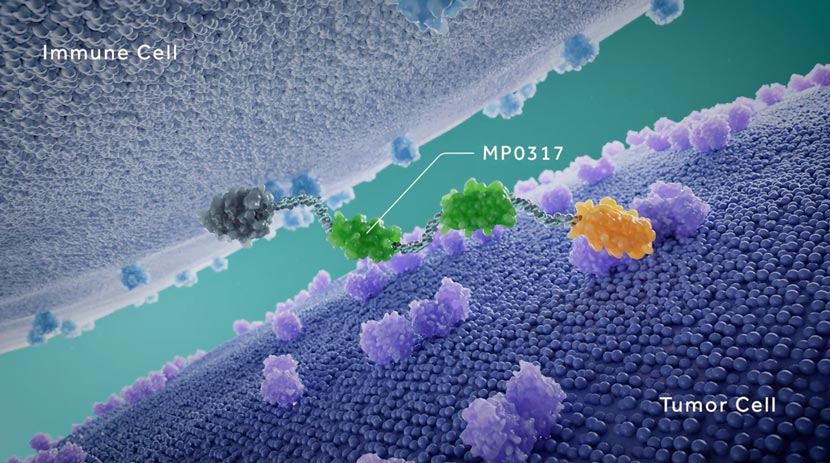
Mechanism of Action
MP0533 / CD33 x CD123 x CD70 x CD3: r/r AML and AML/MDS
MP0533 is a novel tetra-specific T cell engager designed to kill all acute myeloid leukemia (AML) cells – blasts and also leukemic stem cells known to drive relapse – while minimizing damage to healthy cells. MP0533 targets three antigens preferentially co-expressed on AML cells. The strength of binding to cells increases with the number of targets engaged, thereby strongly favoring binding to AML cells over healthy cells.
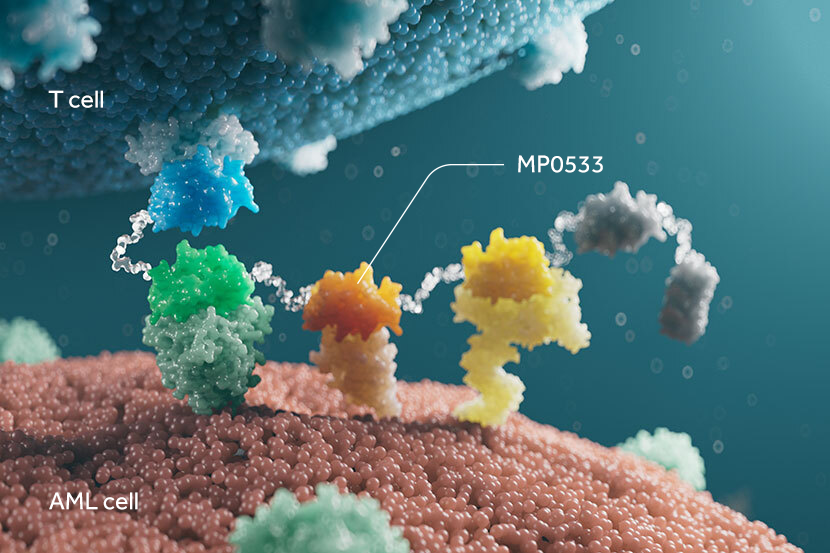
Mechanism of Action
MP0632 / CD3 x CD2 x MSLN X EpCAM Switch-DARPin
MP0632 is a logic-gated Switch-DARPin T-cell engager (TCE), designed to achieve conditional tumor-localized immune activation targeting MSLN and EpCAM, which are highly co-expressed in ovarian cancer and other solid tumors. The CD3-engaging DARPin is unmasked (“Switched” on) and activates T cells only upon binding to both MSLN and EpCAM. MP0632 is half-life extended through a Fc domain, which broadens the Company’s capabilities in half-life engineering modalities.